Promoting Positive Mental Health in Carlow
Carlow Mental Health Association provides free resources, events, and signposting to local and national mental health supports since 2010.

Carlow Mental Health Assoc.
Promoting positive mental health in Carlow

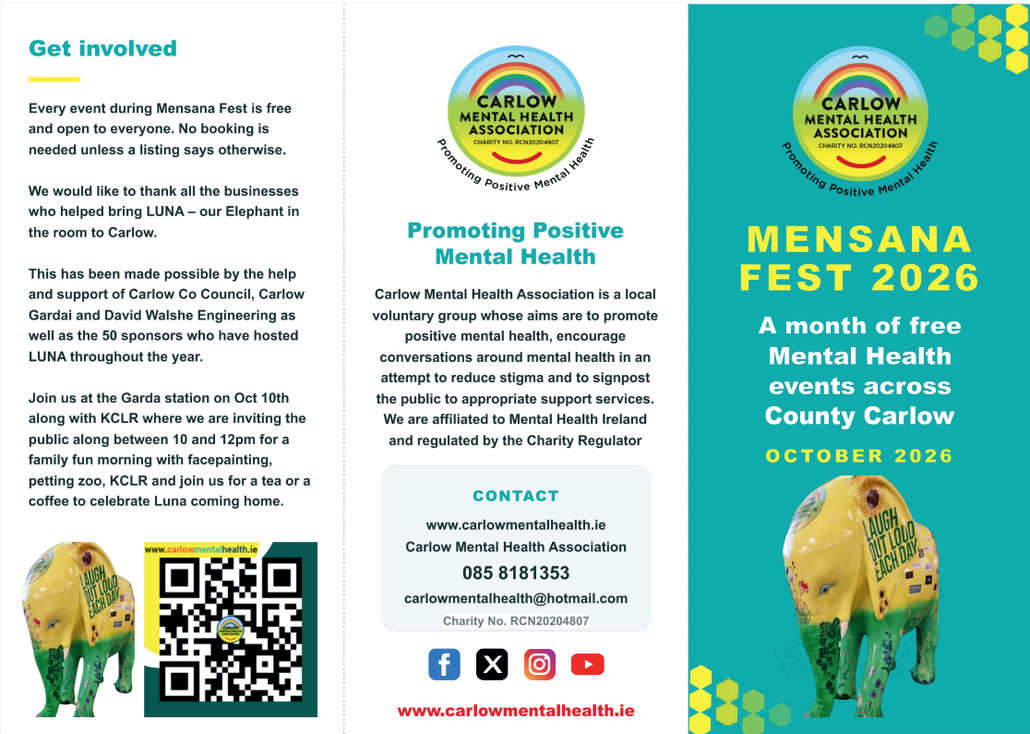
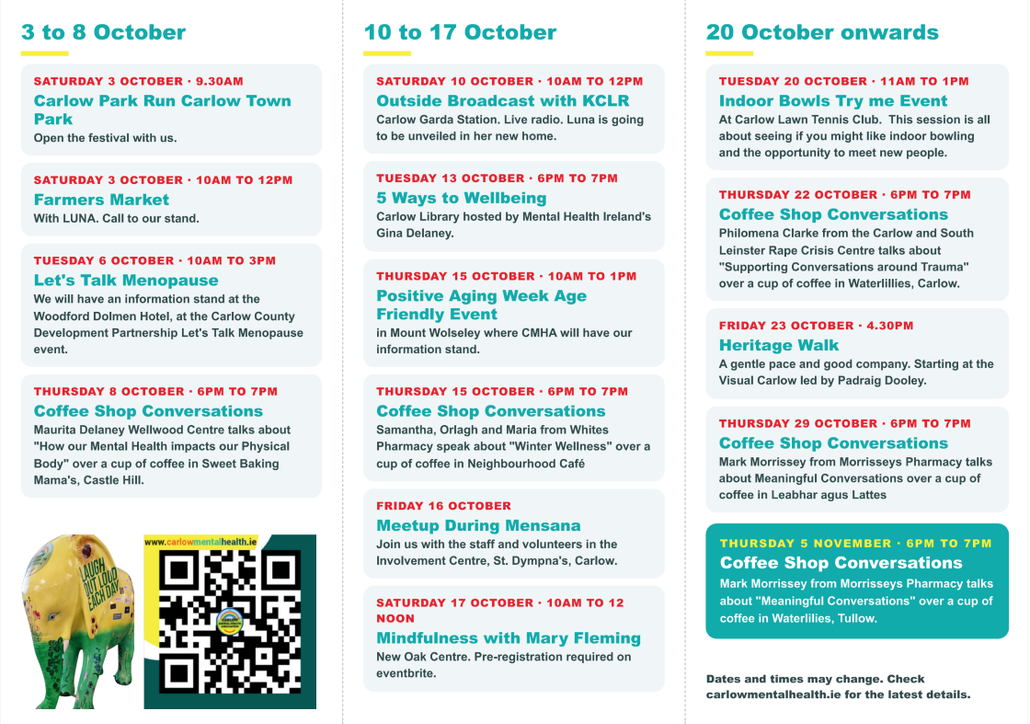
Some days seeing the smiles on peoples faces really brightens the day. Thanks to all who popped by at Carlow Farmers Market on Saturday when Luna was visiting. The warmth of welcome and the enthusiasm from the stall holders made it a great morning.
#mensana2026 #mentalhealthmatters #carlowmentalhealthassociation #carlowmentalhealth #cmha #carlowsfarmersmarket

We are looking forward to being present at the CCDP event Let's Talk Menopause in the Dolmen Hotel. Make sure to register with apeters@carlowdevelopment.ie or call 086 821 9559 to book your place at this event.
#mensana2026 #mentalhealthmatters #carlowmentalhealthassociation #carlowmentalhealth #cmha #carlowdevelopmentpartnership

A quick reminder for anyone who keeps beating themselves up over the past
Please stop replaying your worst moments over and over in your head like a movie you can't turn off.
You cannot change what happened yesterday, and torturing your mind with guilt will never fix the things that are already done.
If you are feeling completely overwhelmed by regret or embarrassed by a wrong choice you made, remember this:
Forget the mistake, remember the lesson, let that sink in:
• You are a human being who is learning, not a perfect machine that never fails: Messing up is literally just a part of growing up, and your slip-ups do not make you a bad or broken person.
• The past is meant to be a teacher, not a life sentence to hold you back: You do not have to carry the weight of who you used to be when you are actively trying to do better today.
• The wisdom you gained from falling down is the exact tool that will keep you standing: That painful moment gave you a deeper understanding of yourself, your boundaries, and your worth.
• Forgiving yourself is the only way you can actually move forward with your life: Let go of the anger and shame, pack up the valuable truth you learned, and leave the rest behind you.
Give yourself permission to wipe the slate clean today and stop letting old choices dictate your current peace. You are allowed to grow, you are allowed to change, and you are allowed to move on from the things you cannot rewrite. 🤍
#mensana2026 #mentalhealthmatters #carlowmentalhealthassociation #carlowmentalhealth #cmha

A quick reminder for anyone who is losing faith in where they are headed right now
Please stop letting a heavy chapter convince you that the entire book is going to end in sadness.
Your current struggles are not your final destination, and you have so much beautiful potential left to unlock.
If you are feeling completely lost, doubtful, or terrified of what the future holds for you today, remember this:
Believe in yourself, your journey, and a brighter tomorrow, let that sink in:
• You possess an incredible inner strength that has never failed you yet: Trust your own capability to handle the hard moments because you have proven time and again that you can survive.
• Your path does not have to look like anyone else's to be completely beautiful: Every single twist, turn, and delay in your life is shaping you into exactly who you are meant to be.
• The dark clouds you are standing under right now will absolutely give way to light: The sun has never failed to rise after a dark night, and your life will find its warmth again too.
• The best days of your life haven't even happened to you yet: There are so many incredible people to meet, core memories to make, and beautiful moments just waiting for you in the future.
Give yourself permission to let go of the worry and step forward with an open, hopeful heart today. Trust your own strength, trust your unique pace, and hold onto the absolute certainty that better days are coming. 🤍
#mensana2026 #mentalhealthmatters #carlowmentalhealthassociation #carlowmentalhealth #cmha #carlowfarmersmarket

A quick reminder for anyone who feels like they’ve completely ruined their own path
Please stop convincing yourself that a setback, a failed attempt, or a wrong turn means your story is officially over.
You are not stuck in the past, and you do not have to keep walking down a road that no longer serves your peace just because you spent a lot of time on it.
If you are feeling completely defeated, embarrassed, or like you have to build your whole life from scratch right now, remember this:
It's Ok to start over and try again.
Let that sink in:
• Starting over is not a failure, it is an act of incredible courage: Choosing to walk away from what isn't working and trying a new direction takes massive strength.
• You are never actually starting from scratch, you are starting from experience: You carry all the lessons, wisdom, and resilience from your past attempts into your fresh start.
• There is absolutely no timeline or expiration date on finding your happiness: It does not matter how many times you have to reset, change your mind, or reinvent yourself along the way.
• Every single morning is a natural permission slip to try a different approach: Your past mistakes do not lock you into a box, and you are allowed to change your story whenever you want.
Give yourself permission to let go of what didn't work out yesterday and look at today with fresh eyes. Clean the slate, take a deep breath, and remember that you are allowed to keep trying until you find exactly where you belong. 🤍
#mensana2026 #mentalhealthmatters #carlowmentalhealthassociation #carlowmentalhealth #cmha

Tomorrow find us at Carlow's Farmer Market from 10 until 12. Call over for a chat and get a picture with LUNA.
#mensana2026 #mentalhealthmatters #carlowmentalhealthassociation #carlowmentalhealth #cmha #carlowfarmersmarket

Tomorrow we will be at the Park Run in Carlow from 9:30. Come and say Hello.
#mensana2026 #mentalhealthmatters #carlowmentalhealthassociation #carlowmentalhealth #cmha

A quick reminder for anyone who feels like they are completely on their own right now
Please stop convincing yourself that you have to earn the right to be cared for or that you are a burden to the people around you.
You spend so much time looking out for everyone else, but you constantly isolate yourself because you think you have to handle every single battle alone.
If you are feeling lonely, unseen, or like you don’t want to bother anyone with your heavy thoughts today, remember this:
You deserve love, care and support.
let that sink in:
• Your worth is not based on how useful you are to other people: You do not need to constantly fix things, be strong, or perform just to be worthy of someone's affection.
• Asking for help is a sign of incredible strength, not weakness: Letting people in and telling them that you are struggling takes massive courage, and you don’t have to do this all by yourself.
• The people who genuinely love you want to be there for your dark days too: You are not a chore or an inconvenience to the right people, and they want to hold your hand through the storm.
• You deserve the exact same energy and warmth that you give away to the world: You are just as worthy of a soft space to land, a listening ear, and a tight hug as anyone else on this earth.
Give yourself permission to reach out to someone today, open up, and let them show up for you. You do not have to carry the weight of the world on your own shoulders, and you deserve to be loved exactly as you are. 🤍
#mensana2026 #mentalhealthmatters #carlowmentalhealthassociation #carlowmentalhealth #cmha

A quick reminder for anyone who feels guilty for taking time for themselves
Please stop thinking that you always have to be available, productive, or solving everyone else's problems. Your mental health is not a secondary priority, and you cannot keep running on empty just to keep everyone else happy.
If you are feeling bad about saying no or taking a day off to just breathe, remember this:
Self care isn't selfish, let that sink in:
You cannot give away love, energy, or support that you don't actually have: Taking care of your own mind and body is the only way you can show up for the people you care about.
Rest is a basic human necessity, not a reward you have to earn: You do not need to push yourself to the absolute brink of burnout before you finally allow yourself to pause.
Setting boundaries is how you protect your peace and stay healthy: Saying no to others so you can say yes to your own well-being is an act of survival, not selfishness.
You deserve the exact same compassion you give to everyone else: You spend so much time making sure others are okay, but you belong at the top of your own care list too.
Give yourself permission to log off, step back, and do whatever you need to do to feel human again today.Taking care of yourself isn't a luxury—it is literally the most important thing you can do for your own life. 🤍
#mensana2026 #mentalhealthmatters #carlowmentalhealthassociation #carlowmentalhealth #cmha
How We Can Help
Browse our key areas of support and information for the Carlow community.
Mental Health Supports Available
We signpost to a wide range of supports for individuals and families in Carlow and nationally.
Crisis Supports
Immediate emergency help
Counselling
Professional counselling services
Carlow Based Supports
Local supports in your area
Regional & National
Wider support networks
Young People's Supports
Youth mental health services
Drug, Alcohol & Addiction
Substance use support
Older People's Supports
Services for older adults
Bereavement Supports
Grief and loss support
Suicide Supports
Suicide prevention & aftercare
News and Events
Latest News
- 24 Sep
- 23 Sep
Mensana Fest 2026 – CMHA Info Stand at Carlow Farmers Market
Find us at the Farmers Market alongside LUNA. Call over for a chat, pick up…
- 23 Sep
Mensana Fest 2026 – Info Stand at Let’s Talk Menopause Event
We have an information stand at the CCDP Let's Talk Menopause event. Call over for…
- 23 Sep
Mensana Fest 2026 – Coffee Shop Conversations: How Mental Health Impacts Our Physical Body
Speaker: Maurita Delaney, Wellwood Centre. How our Mental Health impacts our Physical Body. Have a…